Breaking Through with China’s Indigenous Chip for Shipborne Communications and Navigation Systems
On the afternoon of July 10, in Yangzhou, on the northern bank of the Yangtze River, a group of special visitors boarded a methanol dual-fuel ultra-large ore carrier that had not yet left the factory. But they were not there to inspect the ship's hull; they came to see the ship's "brain."
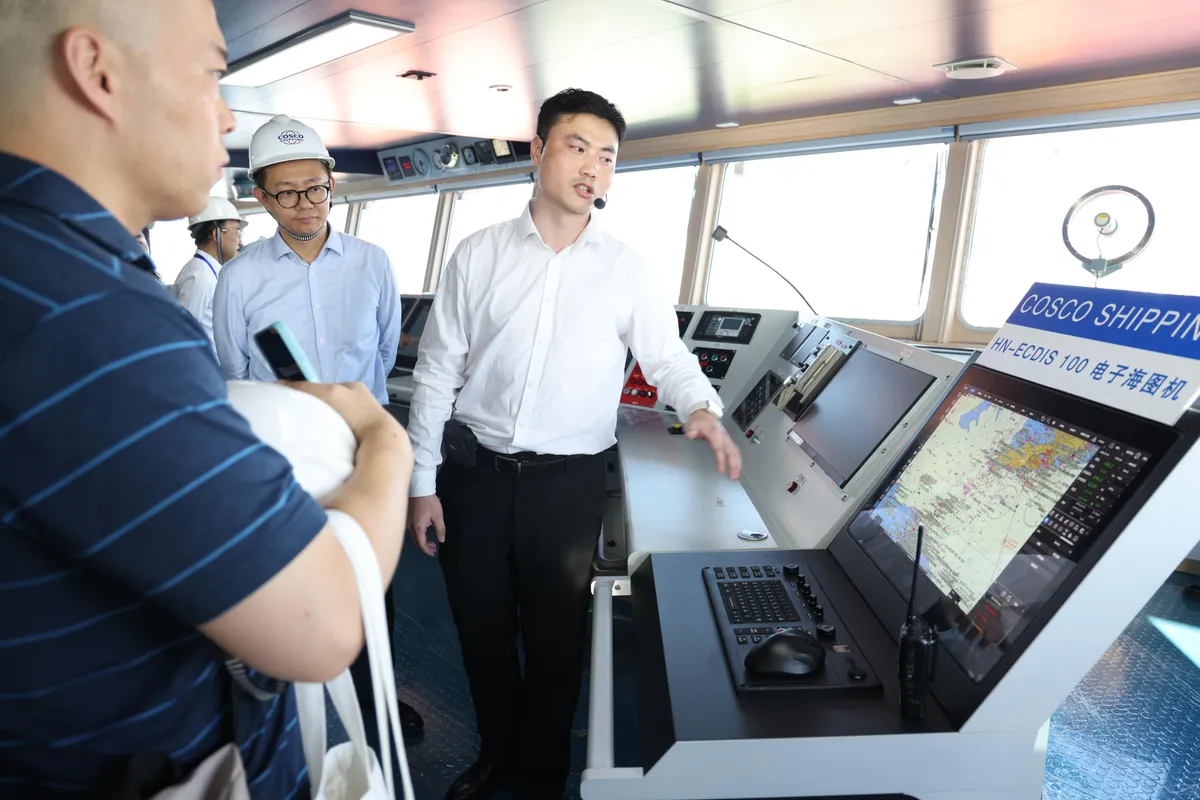
Inside the bridge, four screens were arranged in sequence: an electronic chart display system, a ship-to-shore satellite communication terminal, a meteorological navigation interface, and a crew health monitoring terminal. They all share a common label—independently developed by COSCO Shipping (Guangzhou) Co., Ltd. (referred to as Guangzhou COSCO Shipping).
This was not just a technical demonstration but also sent a positive signal: in the field of ship communication and navigation, which has long been dominated by foreign brands, Chinese companies are striving to shed the label of "followers" and are taking solid steps toward parallel advancement.
Fully Domestic Communication and Navigation System Breaks the Dilemma
"HN-ECDIS 100 achieves 100% domestication, from the operating system, chips, and mainframe to the display and control unit," said a technician from Guangzhou COSCO Shipping Haining Technology Co., Ltd. (referred to as Haining Technology), a subsidiary of Guangzhou COSCO Shipping, pointing at the screen.
This is a significant detail.
Currently, the ship communication and navigation industry faces the "two 90%" situation: over 90% of China's foreign trade cargo volume relies on maritime transport, but over 90% of key communication and navigation equipment for ocean-going vessels depends on imports. Supply chain security is controlled by others, there is a risk of leakage of critical navigation data, equipment maintenance response times are long and costly... Numerous real safety hazards act like a "tightening curse," becoming urgent issues for the industry to resolve.
Faced with the era trends of intelligent, reduced-crew, and even unmanned shipping, if China continues to rely on 90% imported communication and navigation equipment to embrace the future of intelligent shipping, it will lose the opportunity for intelligent development from the data collection end.
HN-ECDIS 100 was developed precisely to address this pain point. In addition to being fully domesticated, it is the first domestically produced electronic chart navigation equipment compatible with both the S-57 traditional standard and the S-100 next-generation international standard. S-100 is the new generation of maritime spatial geographic information standards promoted by the International Hydrographic Organization, set to officially switch in 2029, reshaping the industry's data foundation and navigation paradigm. The system's underlying layer of HN-ECDIS 100 has already been adapted, with no standard barriers. By 2025, according to authoritative evaluations by the China Institute of Navigation, the overall technology of HN-ECDIS 100 reached international leading levels and won the first prize in the Science and Technology Progress Award.
A shipowner representative who used HN-ECDIS 100 early told reporters that after more than a year of use, two things stood out the most: "First, peace of mind in terms of safety. Intelligent route planning, real-time risk warnings, and the integration of Beidou and AIS data are very solid, helping us identify potential risks in complex waters multiple times in advance. The feedback from the bridge is 'quick response, few false alarms, and reliable.' Second, service response—previously, with imported equipment, issues required waiting for foreign engineers to schedule, which could delay a voyage. Now, the technical team is domestic, and phone, remote, or even onboard services are very timely."
The shipowner also mentioned a detail that is often overlooked: "The operating interface fully considers the habits of domestic crew, making it easy to use and shortening the training cycle." It is evident that the significance of domestication lies not only in safety but also in convenience—the interface aligns with the habits of Chinese crew, making operation smoother than some imported equipment.
As of now, HN-ECDIS 100 has signed contracts for over 100 units. Among them, the "New Hongzhuan" vessel equipped with this system is the world's first intelligent research and teaching training dual-purpose ship, tasked with cultivating future navigators and leading intelligent ship research.
Meteorological Navigation System Supports Safe and Green Development
On the other side of the bridge, the screen of the "Freedom" intelligent meteorological navigation system developed by Shenzhen COSCO Shipping Digital Technology Co., Ltd. (referred to as Shenzhen Digital Tech), a subsidiary of Guangzhou COSCO Shipping, was displaying real-time meteorological data.
Since its official application in July 2025, this system has gradually been implemented to serve shipowners, charterers, public services, and logistics in various shipping scenarios, with a total sailing distance exceeding 2.7 million nautical miles. It integrates multidimensional data such as global atmosphere, ocean, and waves, with a forecast accuracy of 0.1 degrees, providing high-precision forecasts within 10 days and sub-seasonal forecasts within 45 days. Unlike traditional meteorological navigation products, it establishes a "ship-side + shore-side + cloud-side + mobile-side" four-in-one service system, coupling electronic charts with real-time meteorological and sea condition data, building a multi-objective route fuel consumption model, and featuring proprietary algorithms for stall calculation and ETA (estimated time of arrival) prediction.
On-site technicians calculated for reporters: through dynamic optimization of speed and route, measured fuel consumption can be reduced by 2% to 3%. For example, in 500 voyages supported by the "Freedom" intelligent meteorological navigation system, the system dynamically optimized speed and route based on real-time meteorological and sea conditions, cumulatively reducing carbon emissions by 9,200 tons and creating overall economic benefits exceeding 20 million yuan.
2% to 3% may not sound like much, but in the context of ocean shipping involving vessels weighing hundreds of thousands of tons, the significance is entirely different. Moreover, as the EU carbon border mechanism is gradually implemented, green shipping transformation has shifted from "initiative" to "cost." Every percentage point of fuel consumption corresponds to real monetary compliance expenses. "Sailing equals carbon reduction" might be the most economical way to address carbon tax pressures.
In terms of risk avoidance, the system can accurately predict meteorological risks such as typhoons and giant waves in advance, intelligently plan avoidance routes based on ship characteristics, and help vessels complete navigation tasks safely and efficiently in complex waters. In ETA management, more accurate port arrival estimates help charterers and ports prepare scheduling arrangements in advance, reducing additional costs caused by port congestion. A shipowner representative nodded in admiration after hearing this: "Previously, meteorological navigation was just a reference; now it can truly calculate the numbers."
Additionally, the ship-to-shore satellite communication solution leverages low-orbit satellite resources and the ship's 5G private network to establish a broadband link between ocean-going vessels and shore-based centers. The offshore health medical terminal enables round-the-clock health monitoring and remote medical access. The four products cover the four dimensions of "chart—connection—navigation—crew," vividly demonstrating the chain collaboration and integration advantages of Guangzhou COSCO Shipping and its partners in the communication and navigation field.
Building an Industry Alliance to Break Down Ecosystem Barriers
What attracts attention is not just the products.
Standing together on the bridge were not only shipowner clients but also experts from the communication industry and technicians from navigation systems. They were discussing the data on the screens with Guangzhou COSCO Shipping's technical staff.
On the morning of July 10, the Ship Intelligent Communication and Navigation Innovation Technology Industry Alliance was officially established in Yangzhou, Jiangsu. The alliance was jointly initiated by Guangzhou COSCO Shipping, Dalian Maritime University, and Wuhan University of Technology, with the first batch gathering 18 units, including navigation protection centers, classification societies, research institutes, key universities, and leading enterprises in the communication supply chain. Five core tasks were clarified: joint technical research, co-building industry standards, validating real-ship scenarios, transforming scientific research achievements, and promoting large-scale applications.
Why is such an alliance needed? The ship communication and navigation industry involves multiple links such as chips, operating systems, communication, navigation, meteorology, and certification. No single company can independently achieve breakthroughs across the entire chain. Without dismantling the "walls" between these links, it is impossible to solve structural issues such as the low degree of autonomy in core technologies, insufficient industry collaboration, and weak standard-setting authority in the domestic ship communication and navigation industry. A relevant alliance representative stated: "Everyone sits together—you provide technology, I provide scenarios, and he provides standards. Together, we can pave the way."
Focusing on Guangzhou COSCO Shipping is no coincidence. In the field of ship communication and navigation, through years of effort, this company has gradually built full-chain capabilities from data to terminals, from software to hardware. In addition to the products showcased this time, Shenzhen Digital Tech, in collaboration with Dalian Maritime University and others, developed the "Star Beacon" full-domain ship celestial vision autonomous positioning system, capable of completing positioning tasks in environments without satellite signals. Its core technology won the second prize in the National Science and Technology Progress Award in 2025. Shenzhen Digital Tech's independently developed S-100 electronic chart engine was included in the 2024 "Central Enterprise Science and Technology Innovation Achievements Recommendation Directory." The HainingChart chart service software is used by nearly 1,500 vessels, ranking first in the domestic market. With tangible products and achievements, they demonstrate that the "eyes" and "nerves" of China's ocean-going fleet are growing their own roots.
It is worth mentioning that communication and navigation are one of the "2" in Guangzhou COSCO Shipping's "2+N" industry structure. The other is shipping environmental protection—its subsidiary Guangzhou COSCO Shipping NetSea Environmental Technology Co., Ltd. is the only company within the group to achieve full-chain operations for ship oily water reception, disposal, and waste mineral oil resource utilization. In 2025, it was approved as the Guangdong Provincial Engineering Technology Research Center. Hainan COSCO Shipping Environmental Technology Co., Ltd. built Hainan's first ship oily water treatment base, filling a provincial gap. In fields such as ship repair and supporting manufacturing, port and shipping engineering management and property operations, shipping cultural tourism, and crew health management, Guangzhou COSCO Shipping will continue to deepen its efforts, fully empowering the high-quality development of the shipping industry.
-
Guarding the Yangtze River's safety, benefiting the livelihood of riverside residents—Anqing Port Maritime Office weaves a dense safety net for the Anqing section of the Yangtze River.3838
-
A thousand sails head to sea, Lianyungang Maritime ensures safe navigation for the full opening of the fishing season.3275
-
The Dalian Port Lightship Returns to Duty in "Stylish Attire"3376
-
Let the treasures of the grasslands reach across rivers and seas.5010
-
The East China Sea Second Rescue Flying Team of the Ministry of Transport has released an “AI” action plan.3345