The Ningbo-Zhoushan Port provides dual support to boost the overseas expansion of the “new three major exports.”
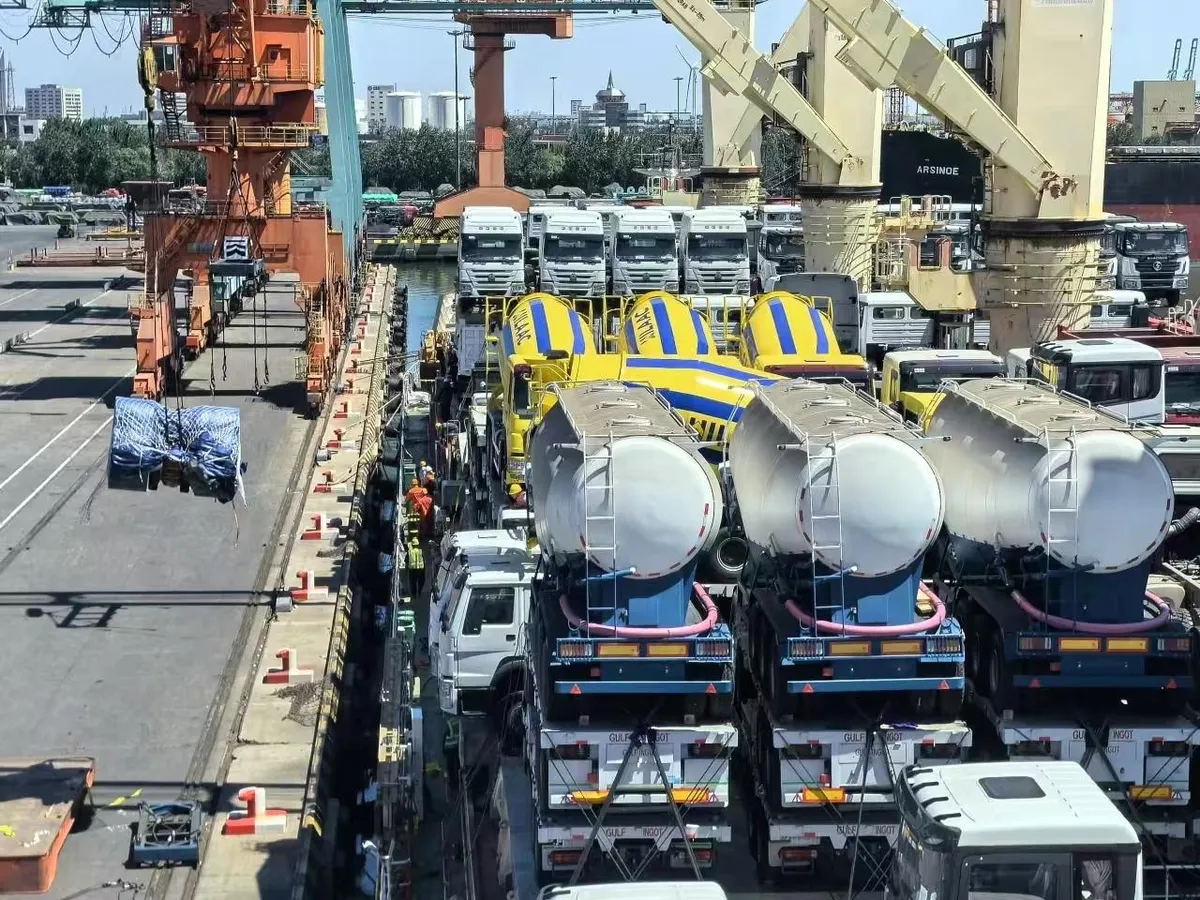
At Meishan Port Area of Ningbo Zhoushan Port in Zhejiang, an LNG dual-fuel ro-ro ship carrying over 5,400 new energy vehicles sounded its horn and set off directly for Europe. Meanwhile, in the workshop of Shuangyi Power (Ningbo) Battery Co., Ltd., a batch of energy storage liquid cooling integrated machines were being packed and ready for shipment.
From the dock to the workshop, Ningbo's foreign trade is undergoing structural changes. In the first seven months of this year, Ningbo's export total of the "new three items" reached 41.36 billion yuan, a year-on-year increase of 1.3 times. Electric passenger vehicles, lithium-ion batteries, and photovoltaic products have taken over from the "old three items" to become the main engines driving foreign trade growth. Behind the impressive data is the "hardcore" strength and innovative services of Ningbo Zhoushan Port.
Over 300 shipping routes carry "Made in Inland" products to the world
On August 5, the "Clean Energy Star" vessel under Ningbo Ocean Shipping Company made its maiden voyage from Meixi Ro-Ro Terminal. After more than twenty days, it unloaded 3,398 new energy vehicles at Gioia Tauro Port in Italy, firmly imprinting the wheels of "Made in China" on the Mediterranean coast.
As the core hub for vehicle imports and exports in Zhejiang Province, Meixi Ro-Ro Terminal's hardware facilities are highly compatible with large dual-fuel ro-ro ships. In the first half of the year, it completed a ro-ro throughput of 285,000 vehicles, a year-on-year increase of 26%, including 167,000 new energy vehicles shipped via ro-ro. The maritime department relies on a dual-line linkage mechanism of "online pre-review + on-site verification," advancing ship seaworthiness inspections and cargo loading stability assessments, compressing customs clearance time by 12 hours, and ensuring transport vessels dock precisely as scheduled.
On August 15, the China-Europe Arctic container shipping route of Ningbo Zhoushan Port entered a new phase of weekly operations during the navigation season. This "Ice Silk Road" shortens maritime transport time between Asia and Europe by nearly 30%. During the navigation window from July to October this year, the route operator plans to arrange at least eight voyages, deploying 7 to 8 ice-class reinforced vessels in rotation. High-value, temperature-sensitive goods such as energy storage cabinets, power batteries, photovoltaic modules, and new energy components from the Yangtze River Delta manufacturing cluster are precisely matched to European market demands.
Shipping routes are the lifeline of foreign trade. Ningbo Zhoushan Port boasts over 300 shipping routes, providing efficient logistics networks for the export of the "new three items" through specialized channels like "China-Europe Express" and "China-Europe Arctic Express." In the first half of this year alone, the Jintang Port Area added 17 new foreign trade routes. A maturing multimodal transport network formed by over 110 sea-rail intermodal routes and more than 40 inland dry ports enables "Made in Inland" products to reach the world via Ningbo.
Leveraging AI glasses for "smart fast clearance"
Unlike ordinary containers, the sea freight export of "new three items" such as lithium battery energy storage cabinets involves complex evaluation conditions and high port support requirements. Ningbo Zhoushan Port, driven by digital reform, has introduced a package of service models such as the "New Three Items Direct Shipping Service," "Direct Loading Upon Arrival," and "Direct Loading from Vehicle to Ship," utilizing technological tools like "AI smart glasses inspection" to achieve a qualitative leap in service efficiency.
The "New Three Items Direct Shipping Service" integrated service platform is continuously iterated, combining enterprise information, logistics dynamics, service applications, and inspection tasks into one data resource. It enables one-stop handling of online reservations, task assignments, progress tracking, and result feedback.
"AI glasses smart inspection" integrates with the "Direct Shipping Service" mechanism, exploring new models of "inspection during loading, instant cloud verification," breaking the limitations of location and time, and achieving dual improvements in supervision and efficiency. Experts can remotely synchronize with factory loading operations and guide on-site verification, saving enterprises at least 24 hours of turnaround time per container.
Meanwhile, equipment such as drones and robotic dogs is gradually being deployed in scenarios like large cargo appearance inspections, site patrols, and remote auxiliary evidence collection. Smart equipment is no longer limited to demonstration scenarios but is addressing real challenges in frontline regulatory services, with significant practical results.
-
Guarding the Yangtze River's safety, benefiting the livelihood of riverside residents—Anqing Port Maritime Office weaves a dense safety net for the Anqing section of the Yangtze River.3838
-
A thousand sails head to sea, Lianyungang Maritime ensures safe navigation for the full opening of the fishing season.3275
-
The Dalian Port Lightship Returns to Duty in "Stylish Attire"3374
-
Let the treasures of the grasslands reach across rivers and seas.5008
-
The East China Sea Second Rescue Flying Team of the Ministry of Transport has released an “AI” action plan.3345