Let the treasures of the grasslands reach across rivers and seas.
On September 10, on the dedicated New Chang Railway line in Hohhot, a train fully loaded with goods such as monosodium glutamate and kaolin was slowly moving towards Tianjin Port, thousands of miles away, and then shipped globally from there. "The flow of goods is smoother, efficiency is higher, and the cargo owners are very happy." The operation of the train has deeply moved Yang Hailong, the sales director of Inner Mongolia New Chang Railway Storage and Transportation Group Co., Ltd., who has been working on the front line of railway transportation for many years.
How far is the distance from the seaport to the grasslands? The answer is becoming clearer through a major two-way sea-land logistics artery.
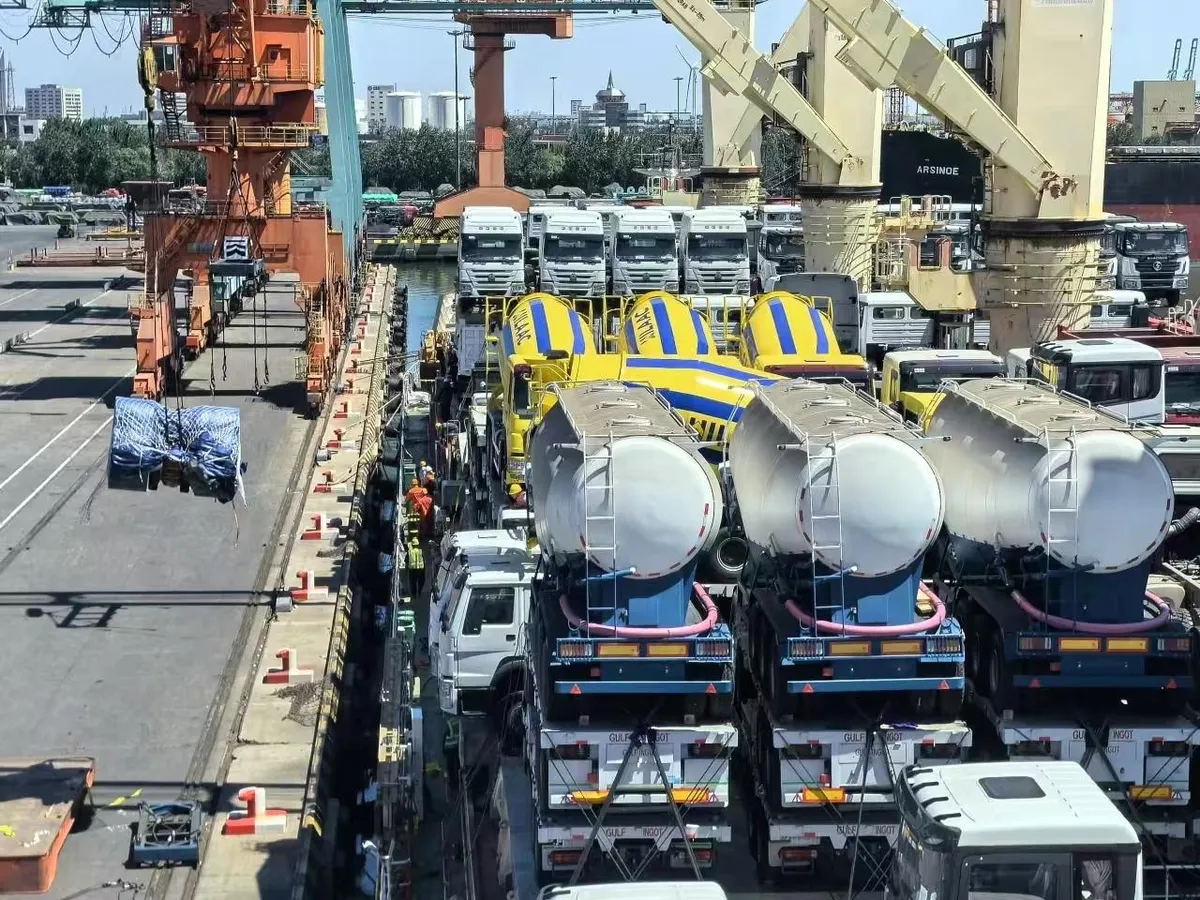
Relying on the reforms of the China (Inner Mongolia) Pilot Free Trade Zone, Tianjin Port continues to strengthen the "two sectors" of sea and land, jointly building a seamless sea-land logistics corridor. It deeply serves the development of key industries in Inner Mongolia, such as energy, metallurgy, chemicals, and agriculture and animal husbandry, effectively bringing the seaport to the "doorstep" of the northern grasslands, and helping Inner Mongolia establish a new high-level pattern of opening up to the north.
Connecting Corridors Activates Inland Economy
Inner Mongolia, the gateway to the northern frontier of the motherland. With a border stretching over 4,200 kilometers, 20 open ports are scattered across the region. China-Europe freight trains run continuously, and industries such as energy, metallurgy, equipment manufacturing, and agricultural and animal husbandry products have a solid foundation. Massive amounts of goods flow in and out of China, Russia, and Mongolia, reaching Eurasia. The freight volume at land ports has consistently led the nation.
However, for enterprises deep in the inland, how to smoothly connect to seaports thousands of miles away? This is a common challenge faced by many local enterprises in Inner Mongolia.
The connection of corridors is the "golden key" to solving this problem.
Currently, Tianjin Port has opened rail-sea intermodal train routes in five major directions: Hohhot, Baotou, Wuhai, Chifeng, and Ulanqab. The number of train routes has reached 12, covering the main industrial nodes across Inner Mongolia. Among them, 10 are scheduled trains operating regularly and stably.
"In April this year, the Chifeng to Tianjin Port rail-water intermodal public train was upgraded to a scheduled train, reducing the total transit time to less than 20 hours. This has established a stable, efficient, and low-cost 'expressway' to the sea for local enterprises and those in surrounding areas of eastern Inner Mongolia," said Lu Siming, general manager of Chifeng Hongshan Zhiyun Logistics Co., Ltd. Train after train is bringing the grasslands closer to the sea.
Inland openness requires not only "corridors" at ports but also "windows" to the sea. Tianjin Port has been continuously advancing the construction of inland hub layouts in Inner Mongolia. Multiple dry port logistics nodes have been established, providing port functions such as inland container storage, loading and unloading, container adjustment, and customs clearance. Enterprises can complete booking, container pickup, and document processing at local dry ports, significantly reducing logistics costs and time.
To address the inland region's challenges of "container shortages, slow container adjustments, and high costs," Tianjin Port relies on its dry port layout and collaborates with shipping companies to create inland container management centers. This ensures the container needs for local enterprises' domestic and international trade exports, effectively reducing port transshipment costs and improving overall transportation efficiency.
"We fully leverage the role of Tianjin Port's inland container management center to provide sea freight container sources for enterprises in Hohhot, creating a 'one-bill' sea-rail intermodal service product," Zhang Guolong told reporters. The container management center allows enterprises to consider their delivery at the Hohhot freight yard as equivalent to port receipt, avoiding the need for transshipment operations at the port, making the entire process worry-free and efficient.
Data demonstrates the increasing resilience of the corridor—by 2025, the rail-water intermodal volume between Tianjin and Inner Mongolia is expected to reach 412,000 TEUs, a year-on-year increase of 9%. From January to August this year, 288,000 TEUs were completed, a year-on-year increase of 2.5%.
Service Extension Unlocks the Chain to the Sea
"The integration of multimodal transport service models has reduced our overall logistics time by 33 to 34 days and costs by 20% to 30%." On September 10, at the Tianjin Port Shipping Joint Conference and the "Four Thousand Actions" promotion meeting for serving Inner Mongolia customers, Tianjin Port signed cooperation projects with enterprises such as Inner Mongolia Junzheng Energy & Chemical Group, Beiben Heavy-Duty Truck Group, and Inner Mongolia Mengniu Dairy Group. Many enterprises shared with reporters the tangible "cost savings" they have achieved.
In the past, inland enterprises exporting a single shipment had to coordinate with trucking companies, freight forwarders, and shipping companies. Once the goods reached the port, they had to queue for transshipment, involving multiple steps, numerous documents, and long cycles.
The current changes are inseparable from the extension of services.
Tianjin Port continues to upgrade exclusive service measures, integrating logistics resources across inland, port, and maritime sectors. It achieves a full-process closed-loop service, from door-to-door collection, warehousing and distribution, trunk transportation, port customs clearance, ocean shipping, to terminal delivery, meeting the diversified, one-stop, and large-scale logistics service needs of Inner Mongolia enterprises.
"Relying on the regional headquarters in eastern and central Inner Mongolia, we provide 24/7 convenient port business consultation, information inquiry, and complaint handling services," said Li Wei, deputy general manager of Tianjin Port Group Logistics Co., Ltd. For key enterprises, Tianjin Port also offers priority processing of procedures and priority arrangement of operations, ensuring smooth cargo export.
The continuously upgraded services have made Tianjin Port a reliable "maritime gateway" for Inner Mongolia to connect with the world, while also establishing Inner Mongolia as a solid core strategic hinterland for Tianjin Port.
Next, focusing on serving the high-quality development of Inner Mongolia's industries, Tianjin Port will continue to upgrade exclusive service measures, further increase the frequency of rail-water intermodal trains, accelerate the layout of logistics nodes in areas such as Tongliao, Ordos, and Wuhai, and promote the expansion and upgrading of dry ports and inland container management centers.
"We will also continue to strengthen value-added services such as bulk commodity trade, bonded blending, and futures delivery, empowering Inner Mongolia's industrial transformation and upgrading, and supporting the cultivation and development of new productive forces in Inner Mongolia," said Li Wei.
From the shores of the Bohai Sea to the foothills of Yinshan, the corridor is extending, and services are upgrading. This efficient, green, and economical sea-land intermodal corridor is connecting the seaport hub with the northern frontier, enabling more quality goods from the grasslands to reach rivers, seas, and the world.
-
Guarding the Yangtze River's safety, benefiting the livelihood of riverside residents—Anqing Port Maritime Office weaves a dense safety net for the Anqing section of the Yangtze River.3836
-
A thousand sails head to sea, Lianyungang Maritime ensures safe navigation for the full opening of the fishing season.3273
-
The Dalian Port Lightship Returns to Duty in "Stylish Attire"3374
-
Let the treasures of the grasslands reach across rivers and seas.5006
-
The East China Sea Second Rescue Flying Team of the Ministry of Transport has released an “AI” action plan.3343