
Sino‑Vietnamese Durian Value‑Chain Cooperation(August 21)
Strengthening Cooperation to Elevate Vietnam-China Cross-Border Durian Supply Chain and Industrial Value
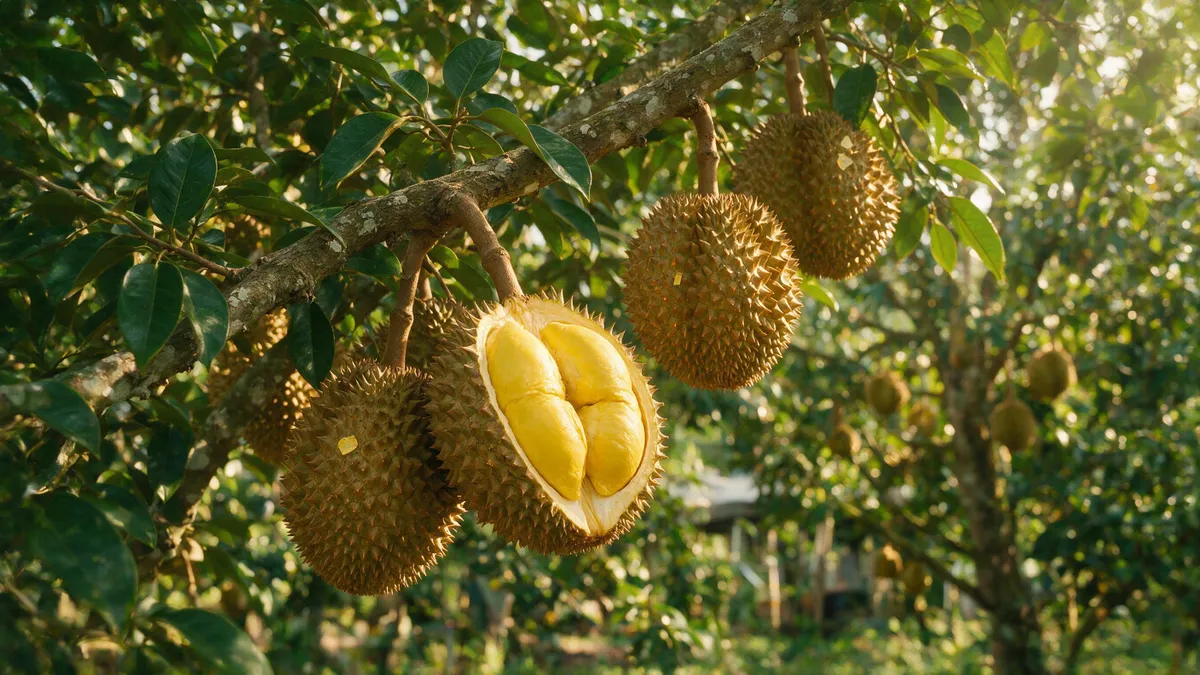
The 2026 Dak Lak Province Vietnam-China Durian Supply Chain Cooperation and Trade Matchmaking Conference not only helps strengthen bilateral connections and promote the expansion of Vietnamese durian exports to China, but also opens new pathways for elevating cross-border supply chain standards, industrial value, and long-term cooperation.
On the afternoon of August 19, the Dak Lak Durian Association held the 2026 Dak Lak Province Vietnam-China Durian Supply Chain Cooperation and Trade Matchmaking Conference in Buon Ma Thuot.
The event gathered representatives from central ministries and Dak Lak provincial departments, as well as nearly 150 enterprises and cooperatives from both countries engaged in durian production, procurement, processing, packaging, and export.
The event coincided with the peak durian harvest season in Dak Lak Province and the Central Highlands, creating favorable conditions for durian trade negotiations, market matchmaking, and sales expansion.
Le Anh Trung, Chairman of the Dak Lak Durian Association, stated in his address that for the durian industry, the Chinese market holds significant importance for Vietnamese farmers and enterprises. In recent years, Vietnam's durian industry has developed rapidly. Dak Lak Province possesses large-scale durian cultivation zones, local farmers have accumulated rich durian growing experience, and the system of durian procurement, packaging, processing, and export enterprises has grown increasingly robust.
However, Dak Lak Province is not satisfied with selling fresh durian alone, and hopes to further deepen cooperation in durian processing, post-harvest preservation, cold storage construction, logistics, e-commerce, traceability, technology, brand building, and market expansion.
Through this event, the Dak Lak Durian Association hopes that Chinese enterprises will share insights on product demand and changing consumer preferences in the Chinese market, as well as Chinese enterprises' needs regarding Dak Lak's durian raw material bases and businesses, and explore opportunities for joint investment and value creation over the next 5 to 10 years.
The Dak Lak Durian Association aims to serve as a bridge, facilitating connections between Chinese enterprises and Dak Lak's farmers, cooperatives, businesses, and relevant authorities, providing matchmaking services in areas such as raw material base identification, export enterprises, processing, cold storage, logistics, technology, and long-term investment.
Tran Van Thang, Vice Chairman of the Dak Lak Durian Association, stated that currently, Dak Lak Province has over 45,000 hectares of durian cultivation, with an estimated 2026 output of approximately 500,000 tons. The durian harvest period in Dak Lak is concentrated from August to November, offering a distinct off-peak season advantage that can provide important seasonal supplementation to the Vietnamese durian supply chain.
Therefore, Dak Lak Province possesses favorable conditions to gradually become a comprehensive hub for agricultural raw material bases, processing, cold storage, logistics, and trade in the Central Highlands region.
Mr. Tran Van Thang stated: Processing facilities or logistics centers established in Dak Lak Province in the future can serve not only local durian production areas but also radiate outward to the broader raw material zones across the entire Central Highlands. This is precisely the advantage that the Dak Lak Durian Association hopes to present to Chinese investors and enterprises.
According to the Dak Lak Provincial Department of Agriculture and Environment, to standardize production processes and improve durian quality to meet export market demands, Dak Lak currently has 280 registered durian cultivation zones covering approximately 7,500 hectares, with an additional 253 cultivation zones totaling 6,532 hectares awaiting approval. Furthermore, 41 fresh fruit packaging enterprises and 16 frozen durian packaging enterprises in the province have been authorized to export to foreign markets. In 2025, Dak Lak's durian export value reached 1.1 billion USD, with China remaining the primary export market, accounting for 70% of the province's total durian output.
Mr. Tran Van Thang stated: The future of Dak Lak's durian industry should not be measured solely by how many additional hectares are planted, but more importantly by how much value can be created per hectare. Therefore, industry development should place greater emphasis on quality, food safety, controlled raw material bases, traceability, deep processing, post-harvest preservation, logistics, and brand building. Moreover, Dak Lak has the conditions to develop regional agricultural infrastructure, promoting the formation of an integrated industry chain from raw material bases to processing parks, cold storage, logistics centers, and export markets. Through this model, the shelf life of agricultural products can be extended, the processing ratio increased, and the value added per kilogram of agricultural products enhanced.
China is not only a critically important consumer market for Vietnamese enterprises, but Chinese enterprises can also play a broader role as partners in jointly developing the industrial value chain with Vietnamese enterprises. Therefore, Vietnamese enterprises hope to deepen cooperation with Chinese counterparts in trade and long-term procurement, deep processing, preservation technology and cold chain, logistics and agricultural trade infrastructure, technology and digital transformation, while actively expanding e-commerce and building brands to further develop the Chinese market.
Mr. Tran Van Thang proposed that guided by the principles of sincere cooperation, shared benefits, and long-term development, enterprises from both countries can jointly build a practical cooperation chain, enabling farmers to have stable markets, Vietnamese enterprises to achieve growth, Chinese enterprises to secure quality supply sources, and consumers to enjoy superior products.
At the event, enterprises and cooperatives from both countries presented the potential and advantages of durian raw material bases in Dak Lak and Vietnam, as well as China's vast consumer market. Additionally, both sides candidly discussed the challenges, obstacles, and increasingly stringent requirements facing durian exports to China. From these discussions, the two countries' enterprises put forward suggestions and solutions for strengthening connections and cooperation, jointly elevating the Vietnam-China cross-border durian supply chain and industrial value.