
Egg Weekly: High-Level Oscillation Continues!(August 27)
Egg Weekly: High-Level Oscillation Continues!
1. Domestic Egg Market Analysis
1.1 Egg Market Price Analysis
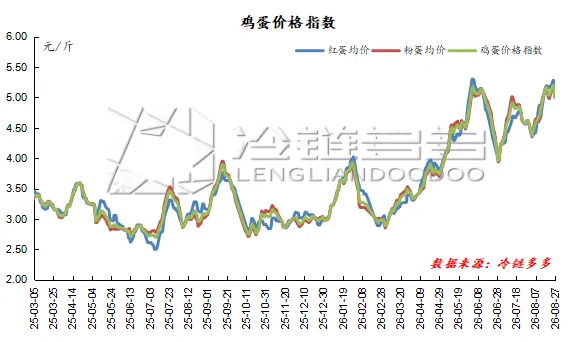
This week, domestic egg market quotes showed mixed movements, but fatigue was clearly evident, with a weak trend remaining the main theme. As of Thursday this week, the average price of brown eggs was 5.00 yuan/jin, down 0.17 yuan/jin from last week; the average price of pink eggs was 5.02 yuan/jin, up 0.01 yuan/jin from last week. The price spread between brown and pink eggs continued to narrow, with a spread of 0.02 yuan/jin. After a period of consecutive rallies, the upward momentum of egg prices has significantly weakened this week. On the supply side, new production capacity continues to be released, and supply increments are gradually materializing; on the demand side, the terminal market's ability to absorb high prices is limited, and the pulling effect is insufficient. Coupled with the spread of bearish sentiment in the market, the factors that previously supported the high-price market are marginally weakening. With multiple pressures叠加, egg prices have entered a phase of phased adjustment.
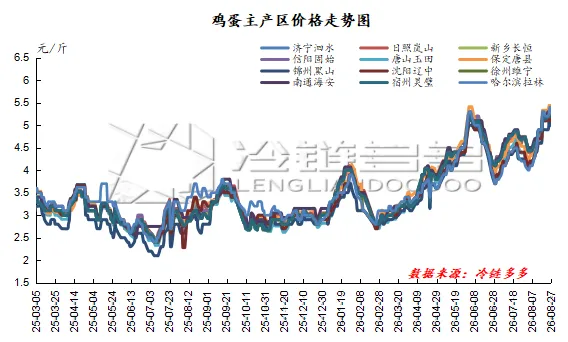
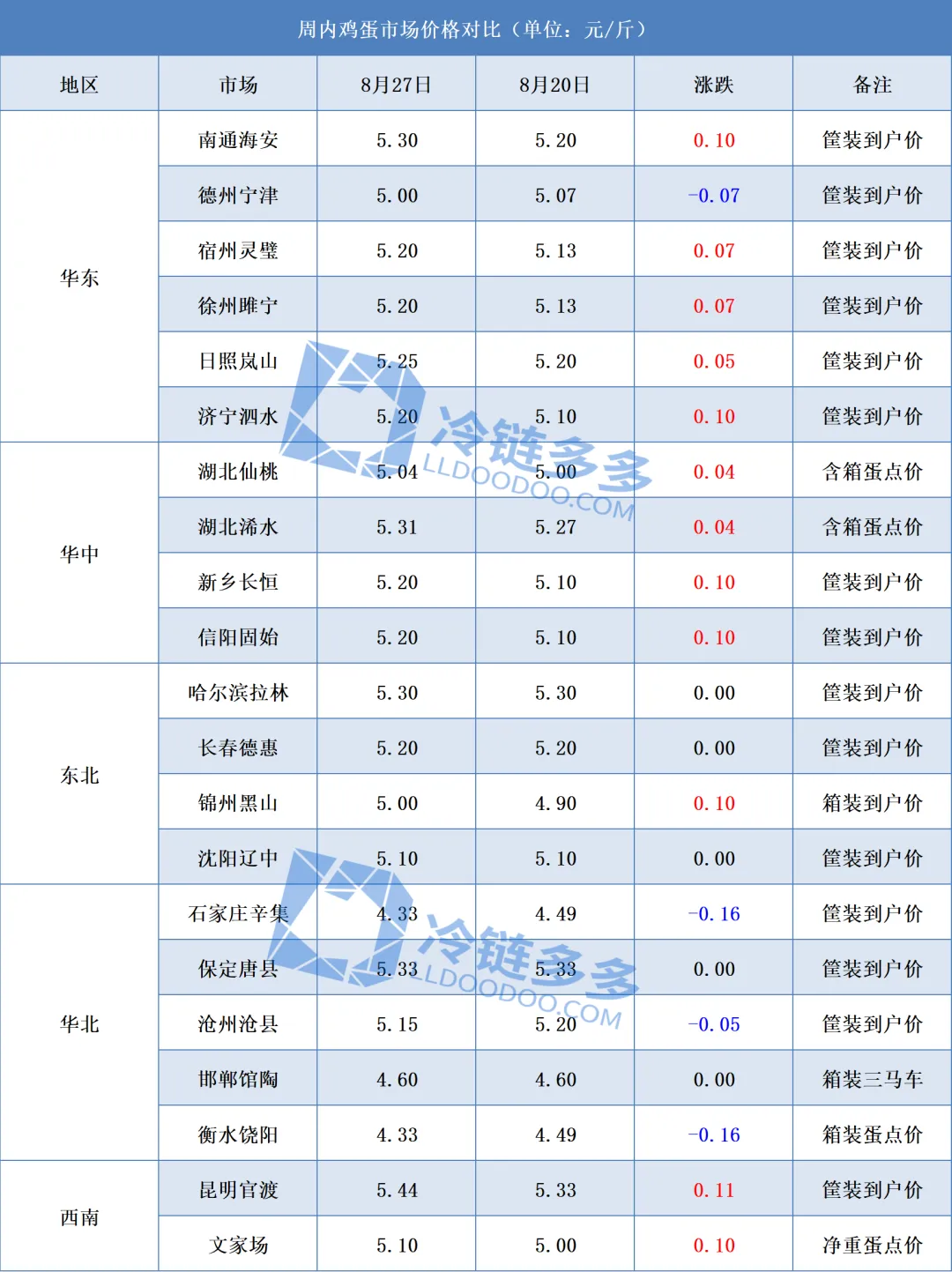
Production areas: As of Thursday this week, the average price of eggs in major production areas was 5.17 yuan/jin, up 0.02 yuan/jin from last Thursday.
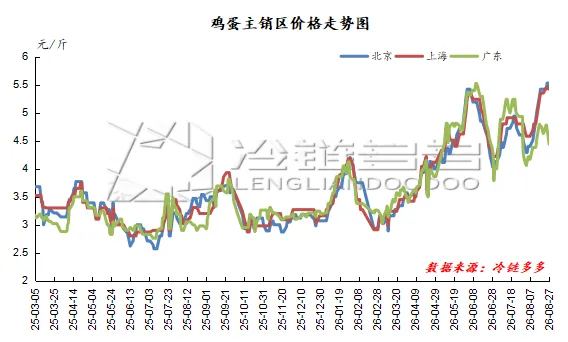
Sales areas: As of Thursday this week, the average price of eggs in major sales areas was 5.10 yuan/jin, down 0.052 yuan/jin from last Thursday.
1.2 Egg Market Price Trend Charts
1.3 Comparison of Domestic Egg Regional Market Prices This Week
2. Analysis of Laying Hen Inventory and Slaughter
2.1 Inventory Analysis
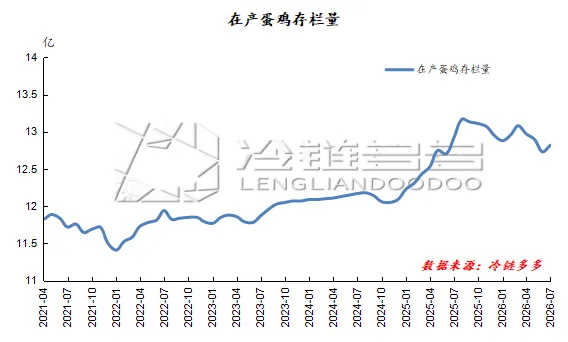
From the perspective of inventory structure, the laying hen inventory in the old hen market remained at a relatively high level this week. Looking at the restocking transmission cycle, newly laying hens in September mainly correspond to chick restocking around May, while chicks restocked in April have basically entered the concentrated laying stage. Moreover, chick restocking volumes in April-May were at relatively high levels within the year, meaning that newly laying hens are about to experience a wave of concentrated production, and the supply side will see significant improvement. The previously tight supply pattern is gradually reversing, and supply-demand relations are entering a transitional phase, with medium-term supply pressure gradually emerging.
2.2 Slaughter Analysis
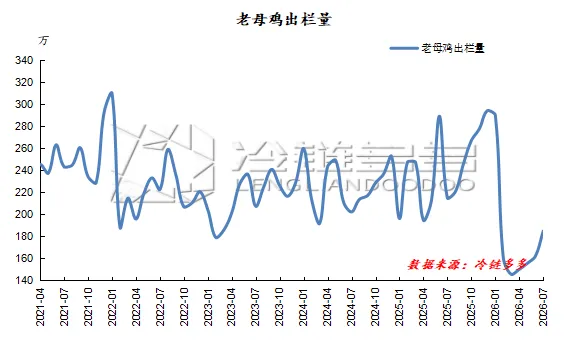
Recently, culling hen prices have shown a rapid downward trend, and slaughter enterprises have a strong willingness to purchase at lower prices. Weakening prices have stimulated the enthusiasm for culling on the breeding side, with culling volumes increasing significantly, and slaughter plant operating rates have risen accordingly. The duration of this round of concentrated culling will have an important impact on the short-term supply pattern, requiring close attention.
3. Egg Demand Analysis
This week, the traditional peak season advantage of the egg industry remains. The Mid-Autumn Festival stocking window has opened, with mooncake and pastry processing enterprises in concentrated production, significantly amplifying egg demand as the primary force driving egg prices upward. Secondly, pre-term cafeteria stocking in schools across various regions has begun, forming a second tier of support from institutional catering demand. Bullish sentiment has driven increased purchasing enthusiasm across all stages of the supply chain, and production area shipment rhythms have improved accordingly.
4. Egg Market Outlook
From the supply side, although the current culling hen market has seen a phased increase in volume, with weakening market conditions triggering panic culling and significantly increased culling volumes, this has formed some offset against short-term supply. However, from the inventory structure perspective, reserve production capacity remains sufficient, previously newly laying hens are successively entering peak laying periods, and peak-period laying hen inventory continues to increase, with active laying hen inventory showing a restorative growth trend. The increase in culling volume is unlikely to fundamentally change the general direction of increasing supply, and the risk of oversupply on the supply side in the later period remains to be guarded against.
From the demand side, with schools starting next week, stocking demand will gradually normalize, making it difficult to see another round of concentrated volume increases in the short term. Although food enterprises remain in the pre-Mid-Autumn production cycle, most operate on a produce-to-order basis, and purchase volumes are unlikely to see significant increases. With some time still before the Mid-Autumn Festival, terminal channels such as supermarkets and farmers' markets generally adopt a purchase-to-sell strategy, strictly controlling inventory levels, with insufficient willingness to actively stockpile. Overall, the demand side faces risks of weakening, and current high prices lack sustained and effective demand support.
Overall, the multiple demand-side logics that previously supported the strengthening of egg prices are gradually weakening, while supply-side pressure continues to accumulate, and supply-demand relations are shifting from tight to loose. It is expected that egg prices will mainly experience high-level oscillation with a weak adjustment bias in the short term, with callback risks in high-price areas gradually rising. The adjustment range is expected to be around 0.15 yuan/jin, with the average price in major production areas at 4.95-5.20 yuan/jin.